Most restaurant owners pick a delivery radius the same way they pick a parking spot: whatever feels close enough. They draw a circle on a map, set it to four or five miles, and move on. Then they spend the next year quietly losing money on cold food, late orders, and one-star reviews that all trace back to the same root cause — a delivery zone that was never designed, just assumed.
Your delivery radius is one of the highest-leverage decisions in your entire delivery operation. Get it right and every order arrives hot, on time, and profitable. Get it wrong and no amount of marketing will save you. Here is how to set it deliberately in 2026.
Why delivery distance decides profit
Every kilometer you add to your delivery zone increases three costs at once: driver time, fuel, and the risk of a refund when food shows up cold. Those costs do not grow in a straight line. A customer two minutes away is almost pure margin. A customer twenty-five minutes away can erase the profit on their entire order — and then cost you again when they never reorder.
The restaurants that win at delivery treat their zone like a financial boundary, not a marketing one. The goal is not to reach the most people. It is to reach the most people you can still serve profitably and with food that arrives the way you intended.
Think in minutes, not miles
The single biggest mistake is drawing your zone in distance. A four-mile trip through a dense downtown can take 22 minutes, while the same four miles on a suburban road takes 9. Distance lies. Drive time tells the truth.
Use a drive-time map instead of a simple radius. Draw your zone around how far a driver can round-trip during your busiest hour, not at 3 p.m. on a quiet Tuesday. If your kitchen is slammed on Friday night and a driver needs 18 minutes each way, that order is on the road for nearly 40 minutes before it reaches the door. Plan for your worst case, not your best.
Benchmarks by restaurant type
There is no universal number, because food does not travel equally. Use these drive-time ranges as a starting point, then tune to your own menu:
- 20 to 30 minutes — the standard zone for most full-service and casual restaurants.
- 15 to 25 minutes — tighten to this for sushi, noodles, fried food, and anything that wilts, sogs, or melts fast.
- 30 to 40 minutes — barbecue, sandwiches, and sturdy dishes can stretch further without falling apart.
- 3 to 5 kilometers — a practical hyperlocal radius if you want speed and freshness over reach.
Domino’s famously draws its zones around how far a driver can go and still keep a pizza above 140°F — usually five to seven minutes out from the store. Your food has its own breaking point. Find it before your customers do.
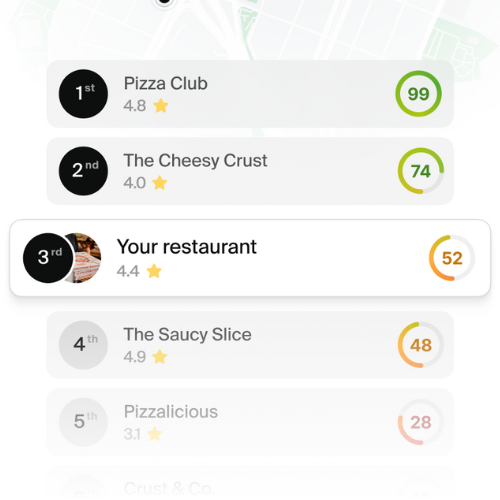
See how your restaurant ranks locally
Do the delivery profit math
Before you commit to a zone, run the numbers per order. Say an average order contributes $8 of margin. If delivering it costs you $3, free delivery works beautifully as marketing — you are buying a customer for a fraction of the profit. But if that same delivery costs $11 once you account for driver pay, fuel, and time, you are paying for the privilege of feeding someone. At that point a delivery fee or a minimum order is not optional, it is survival.
Map this for the edge of your zone, not the center. The orders near your door subsidize the ones at the boundary. If the boundary orders lose money even after fees, your zone is too big — pull it in.
Protect food quality
A zone that is too large does not just cost money. It costs trust. Cold fries and a melted dessert generate a refund, a bad review, and a customer who never comes back — three losses from one order. Every minute on the road is a withdrawal from your quality account.
If you want to deliver farther, invest in the things that buy you time: insulated bags, smarter packaging, dishes that hold heat, and a kitchen that times the cook to the dispatch rather than letting food sit on the pass. Extend your reach with operations, not optimism.
Tighten zones on third-party apps
Here is the part most owners miss. The profitable zone for your own direct delivery is almost never the same as your profitable zone on a third-party app. Those platforms take 15 to 30 percent of every order in commission, which slices straight through your margin. A trip that is comfortably profitable for an in-house driver at 22 minutes might cap out at 12 minutes once a marketplace has taken its cut.
The lesson is not to abandon the apps. It is to recognize that they should run a tighter zone than your direct channel, and that your direct orders — where you keep the full margin and own the customer relationship — can profitably reach the customers the apps can’t. The more orders you pull onto your own commission-free channel, the wider and more profitable your real delivery footprint becomes.
Turn your radius into a strategy
Your delivery zone is not a setting you configure once and forget. It is a living boundary that should flex with your drive times, your menu, your margins, and your channels. Review it every season. Watch where your late and cold-food complaints cluster on the map. Pull the boundary in where you are losing money, and push it out only where the operations can keep up.
Set it deliberately and delivery stops being a leaky bucket and starts being one of the most profitable, customer-owning channels you have. RAY helps you take direct, commission-free delivery orders so the margin stays yours — and so the customers you work so hard to win belong to you, not to a marketplace.
Get commission-free delivery orders with RAY

